
Carnivores Pachydermata Ongulates Reptiles Primates, rodents and others Birds Birds of prey Terrestrial birds Waders and water birds
African Hoopoe

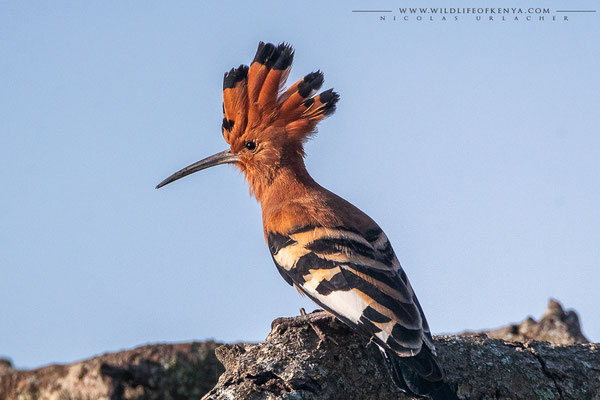

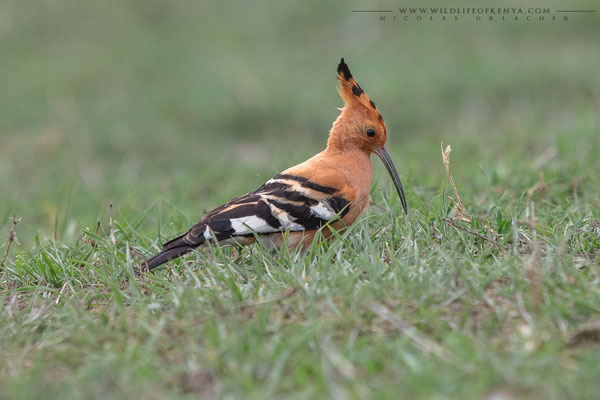
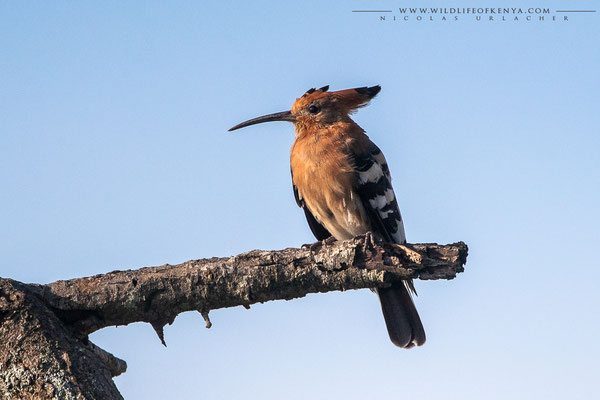


The African hoopoe (Upupa africana) is a distinctively crested, cinnamon-colored bird with zebra-striped black-and-white wings and a long, downcurved bill, commonly found in sub-Saharan open woodlands and gardens. Known for their unique undulating flight, they feed on ground insects and are cavity nesters that can produce a foul-smelling, antibiotic secretion to protect their young.
The African Hoopoe is generally considered a distinct species from the Eurasian Hoopoe (Upupa epops), although they are very similar. The African Hoopoe has a deeper, richer chestnut-cinnamon plumage, lacks the white subterminal band on its crest, and has completely black primaries, whereas the Eurasian Hoopoe is paler sandy-buff with white-banded crests and barred primaries. African Hoopoes are found throughout most of Sub-Saharan Africa and are generally sedentary or partially migratory. Eurasian Hoopoes are native to Europe, Asia, and North Africa, with significant migratory patterns.
Key Facts About the African Hoopoe:
Appearance: They are roughly 25-29 cm in length with a prominent, erectile, cinnamon-colored crest tipped with black. Females are slightly duller and smaller than males.
Behavior & Flight: They have a distinctive, butterfly-like flight pattern. When foraging, they walk on the ground and use their long bills to probe for insects, larvae, and small reptiles.
Habitat & Distribution: They are widely distributed across Southern and East Africa in open, bushy areas, thornveld, and suburban gardens.
Diet: Primarily insectivorous, eating beetles, crickets, locusts, and worms.
Nesting & Defense: They nest in tree cavities, holes in banks, or rock piles. To deter predators, nesting females and chicks can produce a foul-smelling, black,, anti-bacterial fluid from their oil glands.
Call: Their name is derived from their call, a soft, melodic "hoop-hoop-hoop".
